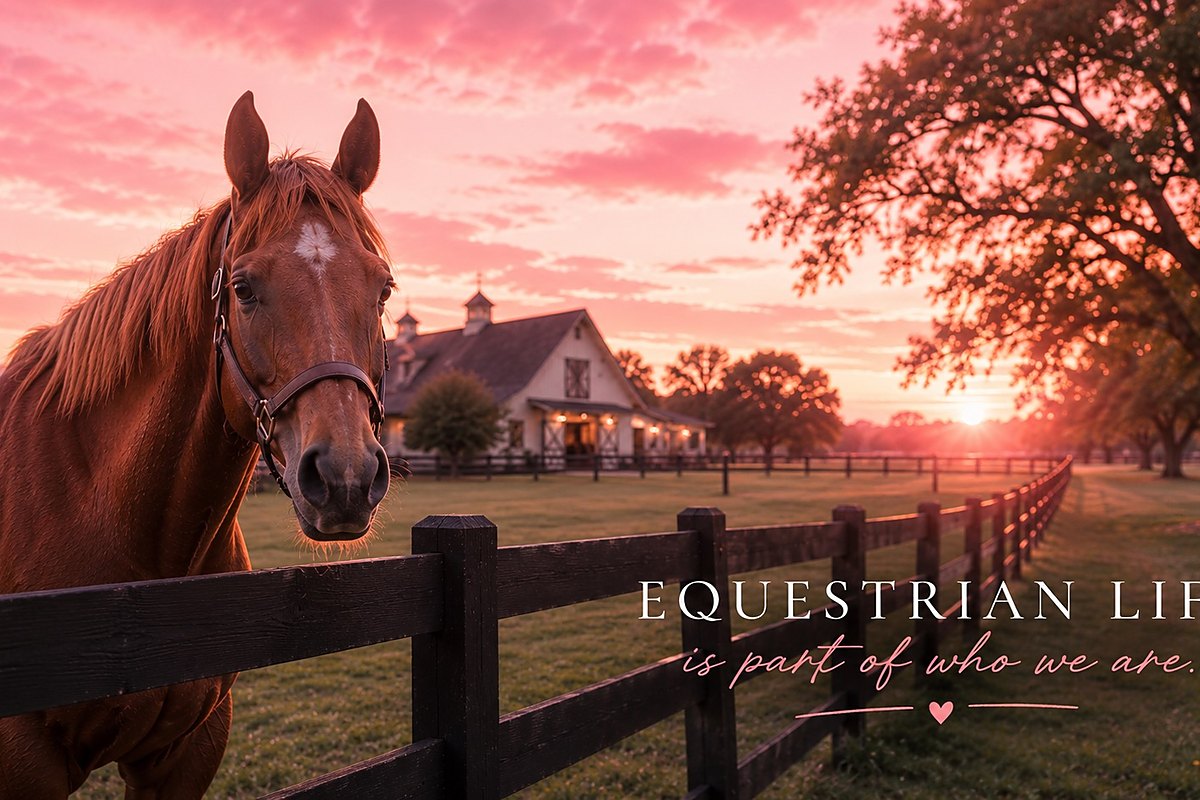
“Can I have horses there?” is one of the most common questions I get in this market, and it is one of the hardest to answer honestly, because the real answer depends on four separate systems that do not talk to each other: city zoning, the animal ordinance, the appraisal district, and whatever a developer recorded against the land in 1998. Here is all four, with the sections quoted, and here is where the traps are.
This is general information from public records, not legal, tax or lending advice. For any specific parcel, verify with the city, the county and the appraisal district before you write an offer. I will do that with you.
That is the first thing that trips people up. Zoning says where a barn may exist. Chapter 6 of the city code says how many horses.
| District | Stable status | Minimum lot |
|---|---|---|
| A — Agricultural | “Farm, ranch, garden, orchard” and a private stable or barn are both permitted uses | 3 acres |
| SFE — Single-Family Estate | Private stable or barn is an accessory use | 1 acre |
| SFR — Single-Family Rural | Legacy district, caps at 20 head of cattle or 15 head of horses; only for properties designated before October 1, 1997 | — |
| SF16, SF10, SF7, SFA and the commercial districts | No stable or farm use listed | — |
The code defines a “Stable or Barn, Private” as “an accessory building for quartering horses, cows, or other domestic livestock,” and a “Farm, Ranch, Garden or Orchard” as an area of three acres or more used primarily for growing farm products and raising farm animals.
This is the section to know by heart if you are shopping SFE lots:
“Tracts or parcels of land of less than ten acres that are zoned as ‘SFE-Single Family Estate’ may maintain horses and/or mules at a rate of two head for the first full acre under fence and an additional one head per fenced acre thereafter.”
Which works out like this:
| Fenced acres | Horses allowed |
|---|---|
| 1 | 2 |
| 2 | 3 |
| 3 | 4 |
| 5 | 6 |
| 9 | 10 |
The same section carries three more requirements that cost real money and that buyers routinely miss:
One more: SFE zoning prohibits livestock generally — except horses and mules. So an SFE lot is a horse lot, not a hobby-farm lot. No goats, no cattle, no sheep.
I am going to be straight with you about a genuine conflict in the ordinance rather than pretend it is not there.
Section 6-8(c)(1) says that “any animal of the order Ungulata” may not be kept on parcels of less than five acres that are not zoned agricultural. Horses are, taxonomically, Ungulata. Yet subsections (2) through (4) expressly allow horses on SFE tracts as small as one acre.
The parenthetical examples in (c)(1) are all exotics — antelope, deer, bison, camels — which strongly suggests the city reads (c)(1) as an exotics rule and (c)(2) through (4) as the horse rule. That is almost certainly the intent. But the text does not say so, and I am not going to resolve a city ordinance for you in a blog post.
If you are buying a Burleson SFE lot under five acres specifically to keep horses on it, call Burleson Animal Control and Development Services and get the answer for that parcel before you remove your option period. Ten minutes on the phone.
Here is something you will not find written correctly anywhere else. Burleson’s zoning ordinance does not define a commercial stable, a boarding stable, or a riding academy. Those uses are not listed as permitted, accessory, or specific-use-permit uses in any district. The Agricultural district’s SUP list covers outdoor amusement, kennels, livestock auctions, religious institutions, veterinarians with outside pens and zoological uses — but not stables.
So if you want to run a boarding or lesson business inside Burleson city limits, it goes through § 18, Classification of new and unlisted uses. Do not let anyone tell you “you just need an SUP.” There is no SUP category for it. There is a determination process, and you want that answer in writing before closing.
This is the single most useful thing in this article and almost nobody explains it.
Texas counties have no zoning authority. In unincorporated Johnson County there is no acreage-per-horse ordinance and no zoning district that forbids a barn. What binds instead is: recorded deed restrictions, septic rules, floodplain, and platting.
Texas Local Government Code § 212.003 bars a municipality from regulating, in its extraterritorial jurisdiction, the use of property, the bulk or height of buildings, building size, or residential density.
Translation: Burleson’s two-horses-per-acre rule does not apply in Burleson’s ETJ. A property can have a Burleson mailing address, a Burleson school bus and a Burleson fire response and still not be subject to § 6-8(c), because it is not in the city. The city can still enforce platting and subdivision rules out there. It cannot tell you how many horses to have.
I see buyers assume the opposite constantly, in both directions — either panicking about a city rule that does not reach them, or assuming a rule protects them from a neighbor when it does not.
Briaroaks (507 residents, 1.1 square miles, sitting just southwest of Burleson) and Cross Timber (362 residents, about four miles south of Burleson) are separate incorporated towns. I could not locate their ordinances, so I will not tell you horses are allowed there. Call the town.
Start with the vocabulary, because the wrong word leads to the wrong expectation.
There is no such thing as an “ag exemption.” It is a special appraisal — the Comptroller calls it productivity valuation. Your land is valued on what it can produce agriculturally rather than on what it would sell for. Nothing is exempted. Almost all rural acreage uses the 1-d-1 open-space track.
The Texas Comptroller’s Manual for the Appraisal of Agricultural Land is explicit, and it is the paragraph that catches nearly every horse buyer:
“If the land is used primarily to show, train, stable, race, care for or otherwise divert livestock from a farm or ranch purpose, that land so diverted is not eligible as qualified open space land.”
And separately: “if the use of the land is principally recreational, or as a hobby, then the activity, although agricultural in nature, is not one that promotes a farm or ranch purpose.” Land used as a stable where horses are kept, fed and cared for “is not being used primarily for an agricultural use, unless the stable is incidental to farm or ranch purposes.”
So:
| Use | Qualifies? |
|---|---|
| Breeding and raising horses as a farm operation | Can qualify |
| Pleasure and trail riding | No |
| Showing and training | No |
| Racing | No |
| Commercial boarding | No |
What people actually do — and I will say this plainly because it is what happens — is qualify the land on a different agricultural use running alongside their riding horses. A few head of cattle or goats grazing the pasture is the common route. That is a legitimate approach if the grazing operation is real and meets the county’s intensity standard. It is not legitimate as a paper fiction, and appraisal districts do look.
Qualified open-space land must have been devoted principally to agricultural use, to the degree of intensity generally accepted in the area, for five of the preceding seven years. So when you buy a tract that already carries the valuation, you are inheriting a history. When you buy raw land that does not, you are starting a clock.
The chief appraiser sets the intensity standard locally, based on the agricultural practices in effect in the area. Minimum acreage, minimum animal units, all of it is county-level.
Johnson County Central Appraisal District does not publish its agricultural qualification guidelines online. I looked at their home page, forms page, reports page and their 2025-2026 Reappraisal Plan and could not find a published minimum acreage or minimum animal-unit figure. Their reappraisal plan confirms the five-of-seven standard and says calculations are done across categories of improved and native pasture, dry crop and wasteland — but no thresholds.
So the honest instruction is: call JCAD at (817) 648-3000, ask for the agricultural department, and get their requirement for the specific tract in writing. Any agent or blog quoting you a Johnson County minimum acreage number is quoting a neighboring county’s guidelines or making it up.
For scale only, and explicitly not Johnson County: neighboring Wise County CAD publishes standards counting one horse as 1.00 animal unit, a miniature horse as 0.50 and a donkey or mule as 1.25, with a minimum tract over five acres and a note that one animal unit requires twenty to twenty-five acres of native range. Wise County is not Johnson County. Do not use those numbers here.
This one I want to correct loudly, because plenty of agents and articles still have the old version.
If the use of land that carries 1-d-1 special appraisal changes, an additional tax is imposed equal to the difference between what was paid and what would have been paid on market value — for the three years preceding the change of use.
The history:
Current law on 1-d-1 open-space land: three years, no interest. A tax lien attaches to the land on the date the change of use occurs. Note that the older 1-d track under Subchapter C still carries interest — but almost nobody is on 1-d.
Why it matters to you as a buyer: if you buy a 10-acre tract carrying ag valuation and then build a house and fence a riding arena over most of it, you may trigger a change-of-use rollback on the converted portion. Three years of the difference, in one bill. Know the number before you close, not after.
Groundwater in Johnson County is regulated by the Prairielands Groundwater Conservation District. Texas Water Code § 36.117 exempts from permitting a well used solely for domestic use or for livestock if the tract is larger than ten acres and the well cannot produce more than 25,000 gallons a day. The district cannot restrict production from an exempt well, though registration is still required.
A five-acre tract does not get that exemption. That is a genuine, expensive difference between a 9-acre parcel and an 11-acre parcel that almost never comes up until it is too late. Prairielands charges a $500 non-refundable registration fee per non-exempt well. Call the district before you count on a well.
State minimums require half-acre lots for subdivisions with public water using individual septic, and one-acre lots without public water. Johnson County is stricter: one acre with public water, two acres on groundwater. Permits go through Johnson County Development Services.
The practical trap on horse property: the septic drain field takes up usable ground. On a five-acre tract with a house, a barn, turnouts and a future arena, the drain field and its required setbacks have to fit somewhere too. I have watched buyers site a barn over a drain field because nobody laid the two plans on top of each other. Do that before you buy, on paper.
Rural Johnson County is largely co-op territory — United Cooperative Services out of Cleburne serves a dozen counties including Johnson — but Oncor territory interleaves and service is parcel-specific. Confirm the provider by address. And budget for it: barns, arena lighting and well pumps often need a new service drop, and co-op line-extension costs are typically borne by the member, not the utility.
I want this to be the thing you remember.
Restrictive covenants are private contracts that run with the land. They are enforced completely independently of any city or county rule. A tract can be zoned Agricultural, sit outside every city limit in Texas, have five acres of good pasture and a barn already standing — and still be subject to a recorded covenant that bans livestock.
Pull the recorded restrictions from Johnson County land records for the specific subdivision before you write the offer. Not the listing’s “horses allowed” checkbox. The recorded document.
Floodplain along the Nolan River, Village Creek and their tributaries is common on Johnson County acreage, and pasture sitting in the floodway is often the cheapest acreage on the market for a reason. Johnson County Development Services handles floodplain development permits for unincorporated areas.
On access: a lot of older Johnson County tracts are reached by recorded easement across a neighbor rather than by county road frontage. That affects lending, whether a gooseneck can turn around, school bus service and emergency response. Verify the easement is recorded and wide enough to actually haul a trailer through.
Johnson County sits across three physiographic regions: the Grand Prairie to the west with alkaline loam over limestone, the Eastern Cross Timbers running down the eastern side of the county with acid loamy and sandy soils, and the Blackland Prairie beyond it with deep, clayey, alkaline soils.
The Cross Timbers belt is the reason. It is a narrow band of blackjack and post oak running down from Oklahoma, and its sandy loam drains — which in practice means better hoof conditions and dramatically less winter mud than you get on Blackland clay two counties east. The belt also sits over shallow groundwater; the Handbook of Texas notes its most important function is preserving water and supplying artesian wells. Open prairie on either side gives you grazing.
On forage: Texas A&M’s extension guidance puts coastal bermudagrass as the best fit for sandy loams and loams with fair to good drainage — which is this soil. Native grasses work on all soil types, and small grains like wheat, oats and rye serve as cool-season annuals. Cautions from the same bulletin worth knowing before you seed a pasture: Kleingrass has been associated with liver damage in horses, sorghum and sudan carry a risk of sorghum cystitis, and tall fescue poses a risk to gestating mares from its fungal endophyte.
I will not give you a single number, because the honest answer is that two very different numbers are in play and conflating them is how people end up feeding hay year-round on land they thought would carry their horses.
Those are not the same number and they are not close. The city can let you keep six horses on five acres. Five acres of unimproved North Texas pasture will not feed six horses. Both statements are true, and the gap between them is a hay bill.
Since everything around here is named for it, it is worth getting right.
The cattle route that crossed Johnson County is what everyone now calls the Chisholm Trail. On period maps it was not called that. The main Texas leg appears on an 1881 U.S. Department of the Interior map designated the Eastern Trail; the stretch through Indian Territory was mapped as the Abilene Cattle Trail. The name “Chisholm’s Trail” properly attached to roughly eighty miles of trade route in Indian Territory, out of a system that ran the length of Texas.
Jesse Chisholm, the trader of Scottish-Cherokee descent it is named for, died in 1868 — before that year’s trail-driving season.
The scale is still staggering. An estimated 5.2 million head of cattle were driven north from Texas between 1866 and 1884, more than 2.4 million of them on this trail during its primary years of 1867 to 1875. Traffic fell off after 1876 when Dodge City opened, and an 1885 Kansas quarantine law finished it.
Two things worth being straight about:
The honest version is better than the tourist version anyway: this county was crossed by the largest cattle migration in American history, and then a railroad made the whole enterprise obsolete and built a town on top of it.
Will Rogers Memorial Center, Fort Worth — 120 acres, 2,500 horse stalls, 2,200-plus indoor cattle ties, buildings connected by underground tunnels, 182 RV spaces. It is internationally known for equestrian and livestock shows and hosts an absurd calendar: three major National Cutting Horse Association events including the World Championship Futurity, the NRCHA Snaffle Bit Futurity, and the APHA World Championship Paint Horse Show, among many others. Roughly thirty minutes up the parkway.
Fort Worth Stock Show & Rodeo — founded 1896, the oldest continuously running livestock show and rodeo in the country. It runs 23 days from mid-January into early February; the 2026 edition ran January 16 to February 7. The rodeo moved to Dickies Arena in 2020, while Will Rogers still hosts the livestock and horse show.
Cowtown Coliseum, Fort Worth Stockyards — built in 1908, 2,400 seats, the first indoor rodeo arena in the United States. Stockyards Championship Rodeo Friday and Saturday nights since 1992, PBR Stockyards Showcase on Thursdays, and it houses the Texas Rodeo Cowboy Hall of Fame.
Johnson County Sheriff’s Posse, 1315 South Main in Cleburne — the local one. Outdoor arena, indoor arena and two event buildings, used for rodeos, ropings, barrel races, livestock shows and community events. They host a PRCA rodeo and a ranch rodeo.
Be careful how you read the marketing on this. The City of Burleson’s page for Chisholm Summit describes over 100 acres of dedicated parkland “including an equestrian center” plus horseback riding trails and ponds. A 2021 council presentation described the equestrian center as an existing facility on the land that will remain as an amenity. But David Weekley Homes currently lists it as a “future amenity center and equestrian center” for a community still marked coming soon.
So: planned or retained, not confirmed operating. If an equestrian center inside your neighborhood is a reason you are buying, get the current status in writing from the developer. Do not buy a rendering.
There are working boarding barns, trainers and farriers all around Burleson, Alvarado, Joshua and Cleburne. I am deliberately not printing a list, because boarding directories are notoriously stale — barns close, change hands and stop taking outside horses, and the prices in those listings are often years old. Ask me and I will make calls, or ask at the Sheriff’s Posse in Cleburne, which is where the local horse community actually talks to each other.
One I can confirm by name and address: Burleson Equine Hospital & Mobile Emergency Service, 755 N. Burleson Blvd. Call them for current services.
None of this is meant to talk anybody out of horse property. It is some of the best land in North Texas for it, the soil drains, the water is shallow, and you are thirty minutes from one of the great equestrian venues in the country. It is just a purchase where the answers live in four different offices, and the difference between the right parcel and the wrong one is entirely in the details.
Looking at acreage? Send me the address before you fall in love with it. I will pull the zoning, the recorded restrictions and the ag status, and tell you what it actually is — including when the answer is to keep looking.
Have me check a propertyFigures current as of August 2026. Populations, prices, city projects and business openings all move — if you are relying on a number here, ask me and I will check it.
REALTOR® · BHHS PenFed Realty Texas
I help buyers and sellers across the Dallas–Fort Worth Metroplex — Fort Worth, Burleson, Crowley and Keller, and the surrounding Dallas area. I write these because they are the questions I answer on the phone every week, and most people never get a straight answer to them. If you have one I have not covered, ask me — I will probably turn it into the next post.